
Intro: Who Needs This + Real-World Context
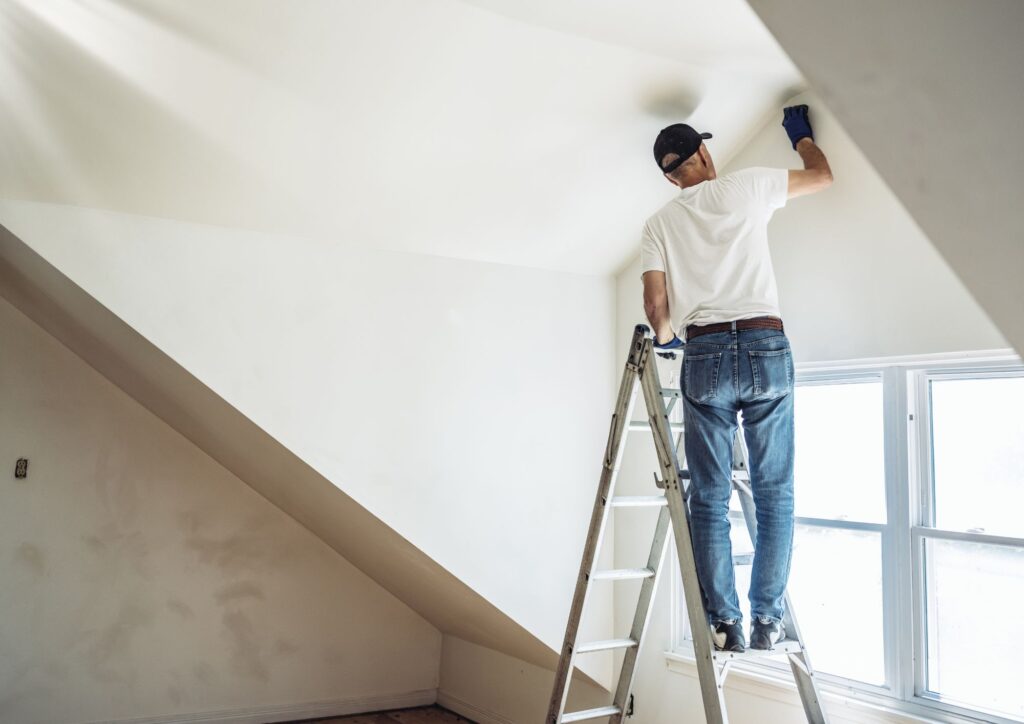
Working over stairs or under high ceilings is one of the most common ways homeowners misuse ladders—and one of the easiest ways to get injured. The issue is rarely recklessness. More often, it’s using a ladder that was never designed for uneven footing or extended vertical reach.
Typical scenarios include changing a chandelier above a stairwell, painting a vaulted ceiling, installing smoke detectors, or cleaning high windows. These tasks often begin with a standard step ladder, which quickly proves unstable on stairs or too short for the reach required.
Staircases create uneven contact points and shift the user’s center of gravity. High ceilings increase the time spent on the ladder and the temptation to overreach. Together, these conditions demand ladders that can adjust, self-support, and remain stable without improvised fixes.
This guide focuses on ladders for stairs and high ceiling work that are realistic for homeowners, DIY users, property investors, and contractor-aware consumers—prioritizing safety, practicality, and informed decision-making over marketing claims.
At-a-Glance Comparison of Top Ladders
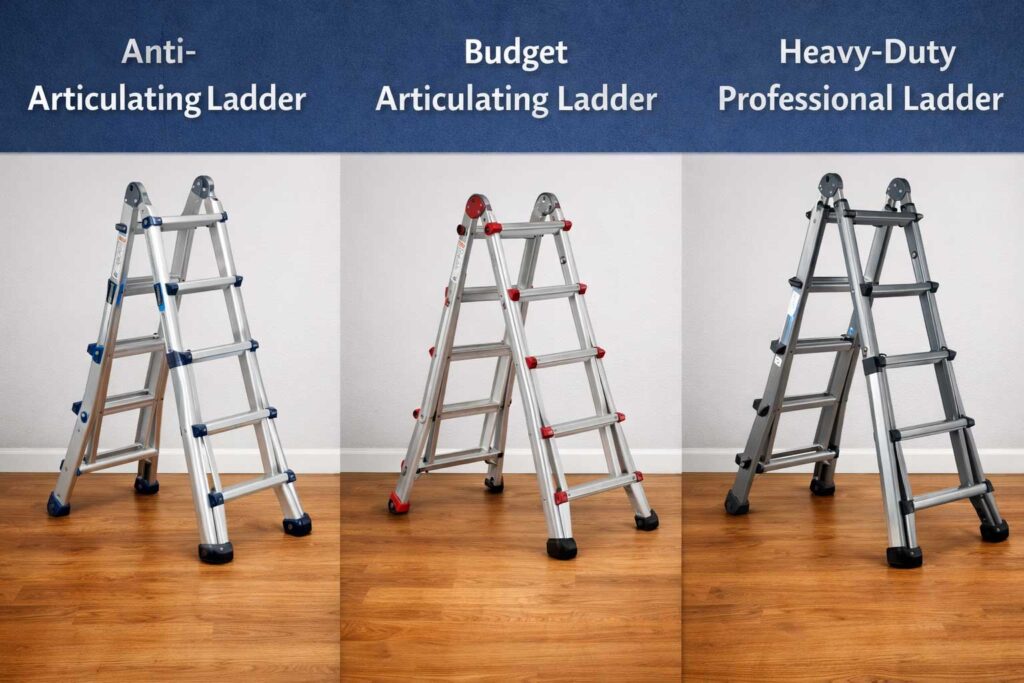
| Product | Ladder Type | Max Reach | Duty Rating | Weight | Stair Compatibility | Self Standing | Best Use |
|---|---|---|---|---|---|---|---|
| Little Giant Velocity 22 | Articulating | ~18–22 ft | Type IA | ~39 lb | Adjustable legs | Yes | Most homeowners |
| Louisville AE2210 | Articulating | ~18 ft | Type I | ~36 lb | Hinged leveling | Yes | Budget/light duty |
| Werner MT-26 | Articulating | ~26 ft | Type IAA | ~58 lb | Independent leg adjustment | Yes | Professional use |
Reach reflects typical working height, not ladder length.
Top Pick for Most Homeowners – Little Giant Velocity 22
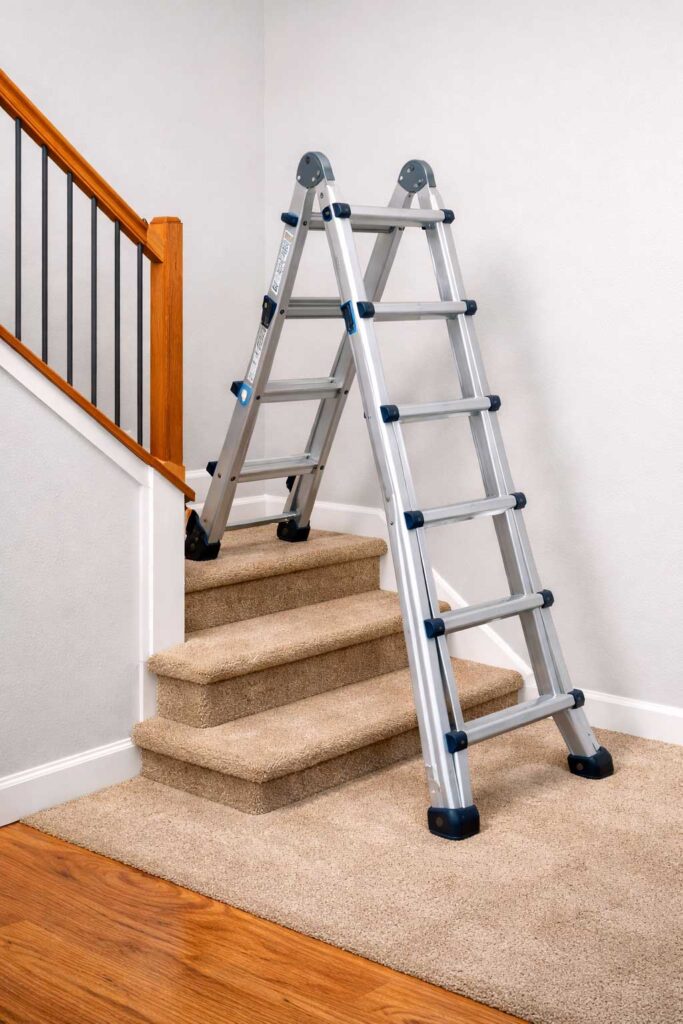
The Little Giant Velocity 22 is well-suited for stair and high ceiling work because it balances reach, stability, and usability without the weight or complexity of contractor-only ladders.
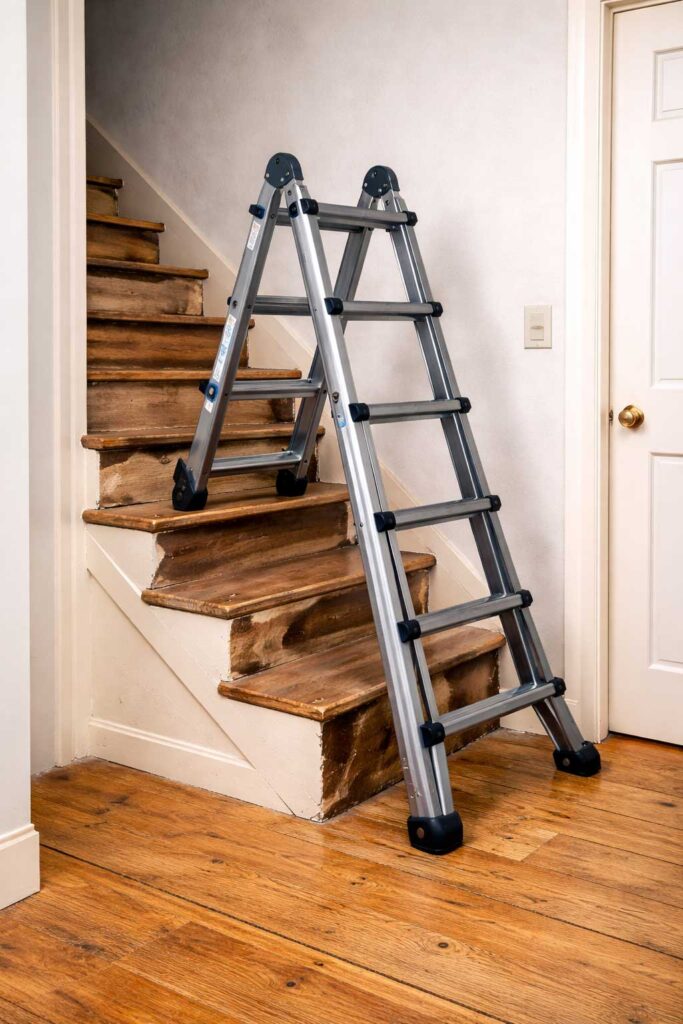
Its articulating hinge system allows the ladder to lock into multiple configurations. On stairs, this allows each side of the ladder to be set at a different height, keeping the rungs level across steps or between a landing and stair tread.
In self-standing A-frame mode, the ladder remains stable as long as the hinge locks are fully engaged. This eliminates the need for shims or makeshift supports, which are a common source of ladder-related accidents in stairwells.
At roughly 39 pounds, it qualifies as a lightweight portable ladder for many homeowners. That matters when carrying the ladder upstairs or repositioning it repeatedly during ceiling work.
The Type IA (300 lb) duty rating provides a practical safety margin for body weight plus tools, without pushing the ladder near its structural limits.
- Best suited for: Homeowners and investors handling occasional but demanding height-related tasks
- Primary limitation: Bulkier storage footprint compared to basic step ladders
Best Value Choice for Light-Duty Use – Louisville AE2210
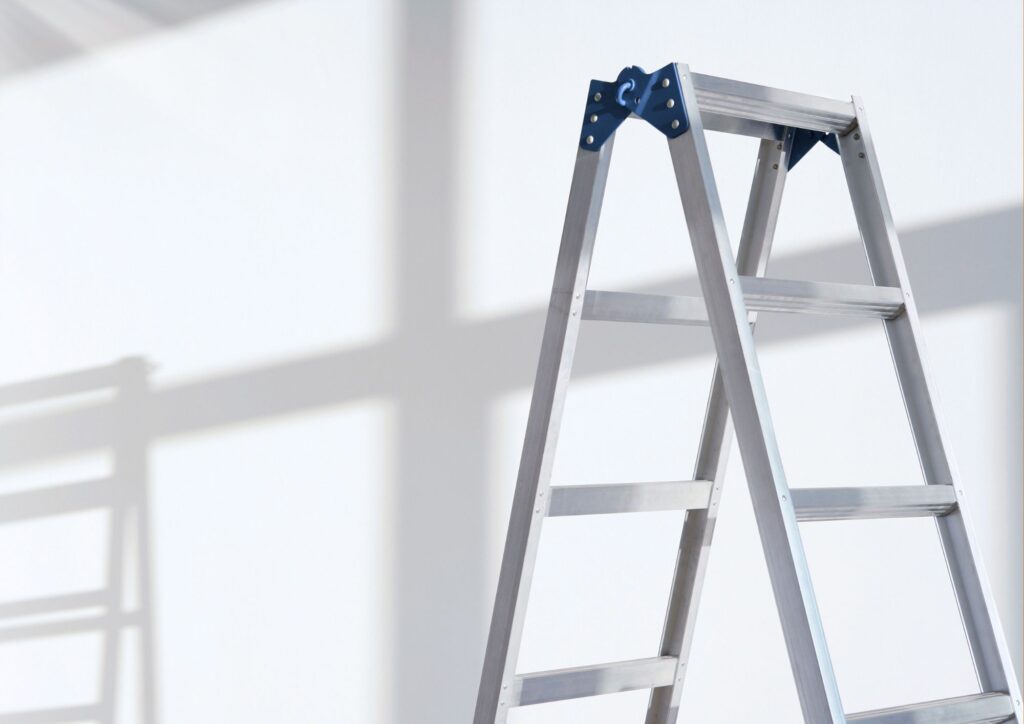
The Louisville AE2210 offers core articulating ladder functionality at a lower cost, making it suitable for homeowners with limited but specific stair-related needs.
It is self standing and capable of basic stair adjustment, meeting the minimum requirement for working safely over steps. Its hinge system provides fewer configuration options, which limits fine leveling but remains adequate for straight staircases.
With a Type I (250 lb) rating, the ladder is appropriate for lighter users and minimal tool loads. Users must be mindful of total weight, especially during overhead tasks where balance and fatigue become factors.
The lighter construction improves portability and storage convenience, particularly in smaller homes. However, reduced mass also means less inherent stability, increasing the importance of careful placement.
This ladder is best used for short-duration, vertical tasks rather than work that requires frequent lateral movement.
- Best suited for: Budget-conscious homeowners performing occasional stair or ceiling tasks
- Primary limitation: Lower capacity and reduced adjustability
Heavy-Duty Option for Professional or Frequent Use – Werner MT-26
The Werner MT-26 is designed for repeated, high-risk access work and is best suited for professionals or property managers who routinely work at height.
Its Type IAA (375 lb) rating accommodates heavier users, tool belts, and materials with substantial safety margin. This is especially important during long-duration overhead work, where fatigue can compromise balance.
Independent leg adjustment allows precise leveling on irregular stairs and landings, a critical feature in older homes where stair geometry may be inconsistent.
The tradeoff is weight. At nearly 60 pounds, this is not a casual portable ladder for home use. Transporting it upstairs requires planning, and adequate storage space is necessary.
For users who routinely work over stairwells or in multi-story residential settings, the added mass improves rigidity and long-term durability.
- Best suited for: Contractors, maintenance professionals, and heavy-use residential applications
- Primary limitation: Weight and storage demands
Selection Criteria and Evaluation Process
Product selection emphasized real residential conditions rather than manufacturer positioning.
Stair compatibility was essential. Any ladder lacking independent adjustment or articulating capability was excluded, as fixed-leg ladders are inherently unstable on stairs.
Self-standing design was prioritized because extension ladders often lack proper top and bottom support indoors, particularly near stairwells.
Duty rating and ladder weight were evaluated together. Excess capacity improves stability, but only if the ladder can be safely handled by the intended user.
Finally, storage and transport were considered. Ladders that are difficult to store or reposition tend to be misused or avoided, increasing risk over time.
How to Choose the Right Ladder for Stairs and High Ceilings
Choosing the Right Ladder Design for Stair and Ceiling Work
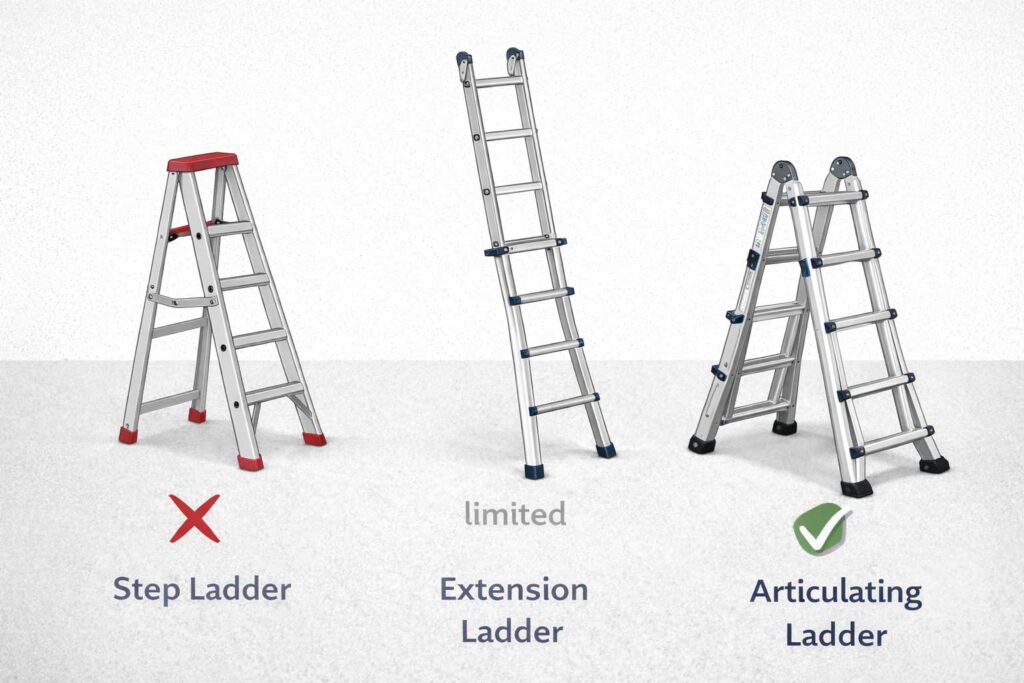
Articulating or multi-position ladders offer the most flexibility for stairs and high ceilings. They can function as step ladders, offset A-frames, or extensions depending on configuration.
Standard step ladders are not designed for uneven surfaces and should not be used on stairs. Extension ladders may work in limited cases but require solid top support and adequate floor clearance, which many homes lack.
For most residences, a self-standing, adjustable portable ladder for home use is the safest option.
Determining Proper Ladder Height and Working Reach
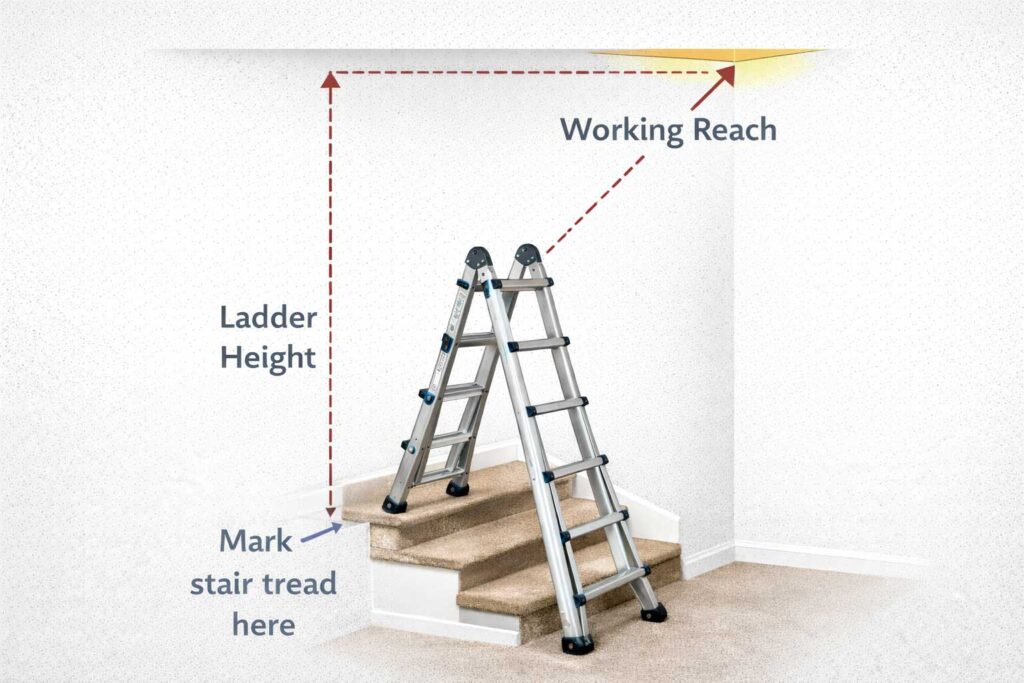
Many homeowners select ladders based on ceiling height alone. This often leads to standing on prohibited steps or overreaching.
Working height reflects where your hands can reach safely, not where your feet stand. In stairwells, measurements should be taken from the stair tread where the ladder foot will rest.
If a ladder only barely reaches, it is undersized. Adequate reach reduces fatigue and improves balance.
Understanding Load Ratings and User Capacity
ANSI duty ratings include the user, clothing, tools, and materials. A 200-pound person can easily exceed 230 pounds once tools are added.
Choosing a ladder with additional capacity reduces flex, sway, and hinge stress—especially when one side of the ladder is lower than the other.
Evaluating Stability and Self-Standing Capability
Self-standing ladders are safer for stair use because they do not rely on walls or railings for support. However, self-standing does not mean self-leveling.
Look for positive-locking hinges, visible lock indicators, and designs that allow unequal leg lengths. Never assume a ladder can adapt to stairs unless it is designed for that purpose.
Key Safety Features to Look for in Portable Ladders
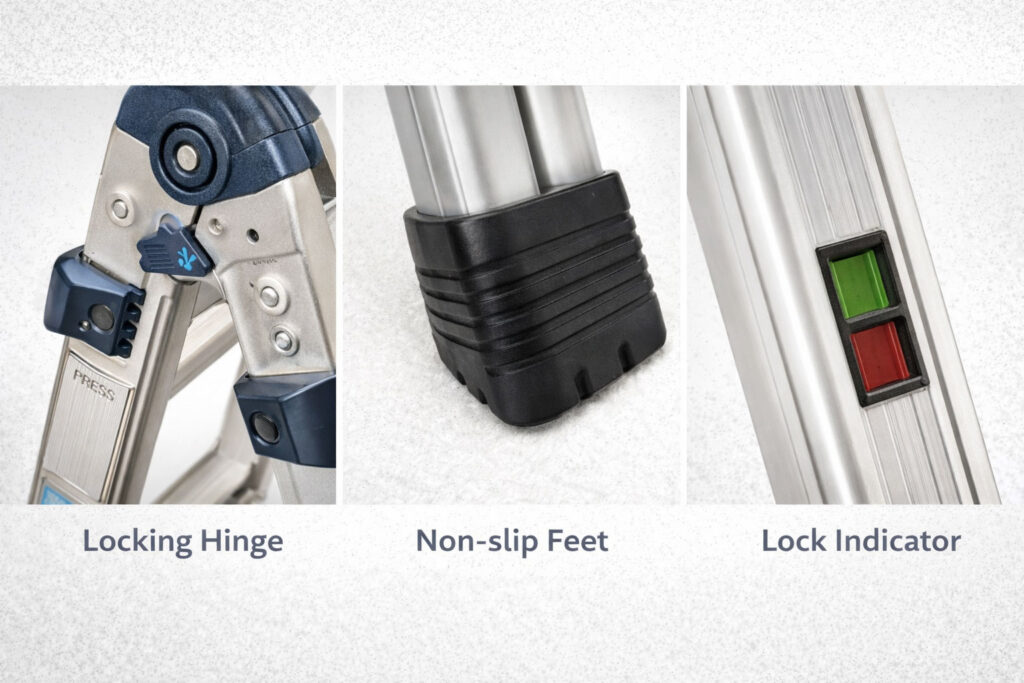
Non-slip feet are essential on hardwood, tile, and stair nosings. Worn feet should be replaced immediately.
Lock indicators reduce setup errors, particularly on articulating ladders. Many accidents occur when a single hinge is not fully engaged.
Anti-pinch joints and smooth hinge operation reduce hand injuries during adjustment.
Balancing Ladder Weight, Portability, and Control
Lighter ladders are easier to carry upstairs but may sacrifice rigidity. Heavier ladders improve stability but increase handling risk.
Choose the heaviest ladder you can confidently move and reposition without assistance. A ladder that is difficult to handle is more likely to be misused.
Common Questions Homeowners Ask
Can I use a regular step ladder on stairs?
No. Step ladders require level ground and become unstable when placed on stairs.
What ladder height is needed for a two-story stairwell?
Typically 18–22 feet of working reach, depending on stair layout and landing height.
Are articulating ladders safe for homeowners?
Yes, when hinge locks are fully engaged and the ladder is properly configured.
How do I level a ladder on stairs safely?
Use ladders designed for independent leg adjustment. Do not use boards or shims.
Is aluminum or fiberglass better indoors?
Aluminum is lighter and adequate for most indoor tasks. Fiberglass is preferred near electrical work.
Do I need a professional-grade ladder for home use?
Only if you work at height frequently or manage multiple properties.
Final Recommendations and Use-Case Guidance
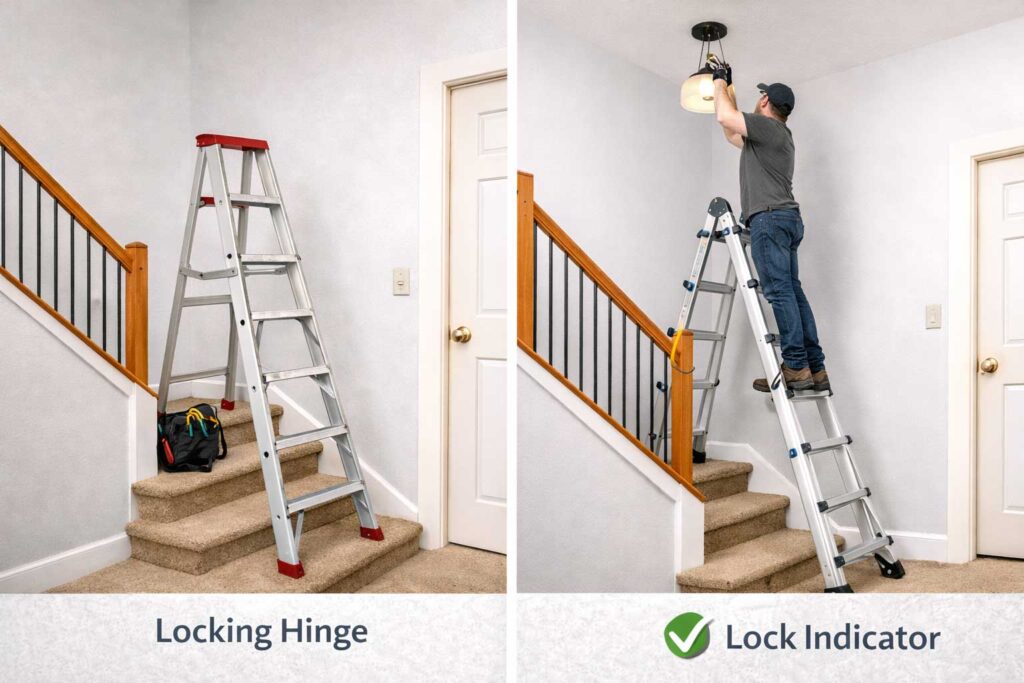
For most homeowners and property investors, an articulating, self-standing ladder with stair-adjustable legs provides the safest and most practical solution for stair and high ceiling work.
Budget models are appropriate for limited tasks but require closer attention to setup and load limits. Professional-grade ladders offer greater safety margins but demand more space, strength, and investment.
The goal is not the tallest or strongest ladder—it is the ladder that fits your home, your tasks, and your ability to use it correctly every time.